Compatibility is a map, not a verdict
When people say two Life Path Numbers are “compatible,” they often mean one of three very different things: easy harmony, workable difference, or catalytic friction. Mixing those up is how numerology conversations go from useful to absolutist.
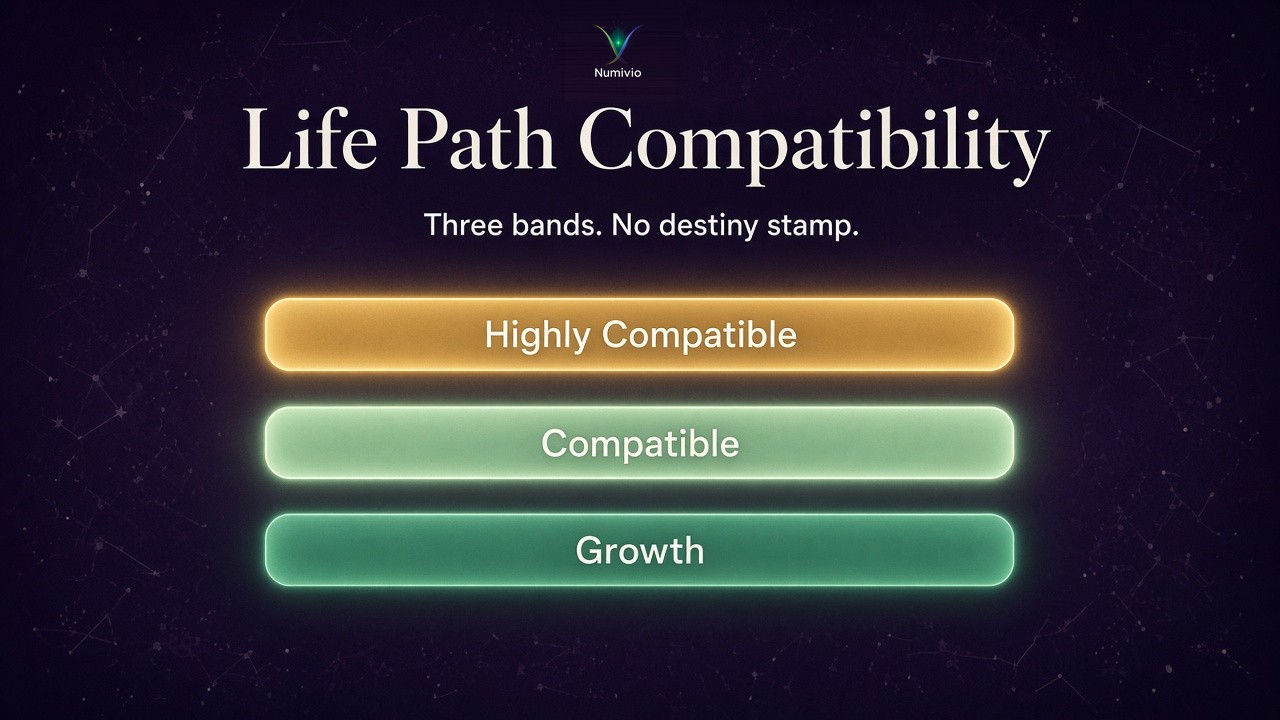
Modern Life Path dating products—and thoughtful practitioners—tend to separate the signal into bands. One clear framing is:
- Highly Compatible — lower structural friction; rhythms often click.
- Compatible — solid potential with normal human work.
- Growth — meaningful stretch; rewarding if both people opt in.
That triad shows up in how Numivio talks about matching: not as a hall pass to ignore behavior, but as a way to set expectations before you invent a story about why the third date felt like a board meeting.
A quick refresher: what Life Path is (and isn’t)
In popular Western numerology, the Life Path Number is calculated from your full date of birth and reduced (with various traditions keeping 11, 22, and sometimes 33 as master numbers). It is commonly treated as a sketch of life themes: leadership, sensitivity, expression, stability, freedom, responsibility, analysis, power, or humanitarian focus—depending on the number.
It is not:
- A morality score.
- Proof of soulmate status.
- A replacement for communication, therapy, or shared logistics.
It is a compact language for tempo and tension. Useful in dating when both people agree it is a lens.
Highly Compatible: ease is a feature—until it isn’t
Highly Compatible pairings usually describe combinations where core drives do not constantly cancel each other. Conversation may feel familiar faster. Conflict styles may need less translation. Day-to-day pacing—social battery, ambition, need for solitude—often lands in a similar zip code.
What Highly Compatible is good for:
- Reducing early misreads (“Are they distant or just a 7 who needs quiet?”).
- Building routines without constant renegotiation.
- Letting chemistry do less heavy lifting as a translator.
What to watch:
- Ease can hide complacency. You still need curiosity.
- “Highly Compatible” is not “conflict-free.” It is “fewer structural headwinds.”
- People change. Numbers are a starting sketch, not a cage.
If you only chase Highly Compatible matches, you may filter out partners who would have expanded your life. Intention matters more than maxing a label.
Compatible: the honest middle
Compatible is where most real relationships live—even outside numerology.
Here, differences exist but are navigable. One person may push for adventure while the other anchors; one processes out loud while the other journals first. The relationship works when both treat difference as information, not indictment.
Compatible pairings reward:
- Explicit agreements (“I need Sunday alone time”).
- Skillful repair after fights.
- Shared goals that outrank stylistic gaps.
This band is where a good dating product should spend marketing honesty. Endless “perfect match” copy trains users to panic when a connection feels merely good. Merely good, tended well, is often the point.
Growth: friction with a purpose
Growth does not mean “bad match.” It means the combination tends to surface edges: control vs. spontaneity, depth vs. lightness, independence vs. merging.
Growth pairings can be:
- Catalytic for people who want evolution and have support systems.
- Exhausting for people who need stability right now.
- Misused as a spiritual excuse to stay in harm (“This chaos is my lesson”).
A sharp rule: Growth requires consent. Both people should know the stretch is mutual—not one person endlessly accommodating while the other calls it destiny.
In product terms, showing Growth openly is a trust move. It says: we will not only sell you butterflies. We will tell you when the road has hills.
How to use the three bands on a real date
- Disclose lightly. “I’m a Life Path 4; structure helps me feel safe” beats a lecture.
- Ask for their experience of the band. Do they want ease, stretch, or something else this season?
- Separate number talk from behavior. Kindness, consistency, and consent outrank any chart.
- Revisit after month one. Labels that helped early should not freeze the relationship’s story.
- Exit superstition fast. If someone weaponizes your number against you, believe the behavior.
Educational traditions differ on which number pairs are “harmonious.” Avoid treating any single blog chart as law. Prefer frameworks that explain why a pairing might feel easy or tense—drive, pace, expression—over mystical pass/fail lists.
Where product design helps (and hypes less)
A numerology dating app earns its keep when it:
- Calculates and presents Life Path clearly.
- Labels matches with readable bands (Highly Compatible / Compatible / Growth).
- Encourages community and conversation, not only binary swipe judgments.
- Keeps CTA language grounded—waitlist, matching, purpose—not “guaranteed twin flame.”
Numivio’s positioning—Align Your Path, Love With Purpose—fits that operator standard: spiritually literate, allergic to pamphlet fluff.
For readers who want to see that framing in product form, the waitlist lives at numivio.app.
Bottom line
Highly Compatible suggests ease. Compatible suggests workable partnership. Growth suggests stretch with upside—and risk.
None of them absolve you of choosing well. Used as a map, Life Path Number compatibility sharpens early decisions. Used as a verdict, it makes you smaller.
Keep the map. Keep your agency. Love with purpose—not with propaganda.